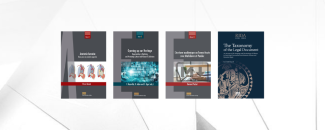
Four new titles have been added to the e-publish catalogue; they are available free of charge in their entirety, in several formats (HTML, PDF, ePub).
These new titles are also available in print as part of a collaboration with Presses Universitaires.
e-publish: ULiège’s open digital publishing platform
e-publish is the platform for the writing, co-authoring, editing and publication of native digital books in Open Access, launched by ULiège Library in 2021. e-publish complements the PoPuPS platform for book publishing, which has been distributing scientific journals in Open Access for over 15 years.
The e-publish catalogue includes monographs, essays, textbooks and conference proceedings, published either by ULiège Library itself or in co-publication with the Presses universitaires de Liège.
Unlike the traditional publishing process, e-publish enables the creation of books that are digital from the outset. This offers numerous advantages: a wide range of enrichment options (images, videos, audio, links, etc.), rapid availability of the work, continuous updates, print-on-demand, and more.
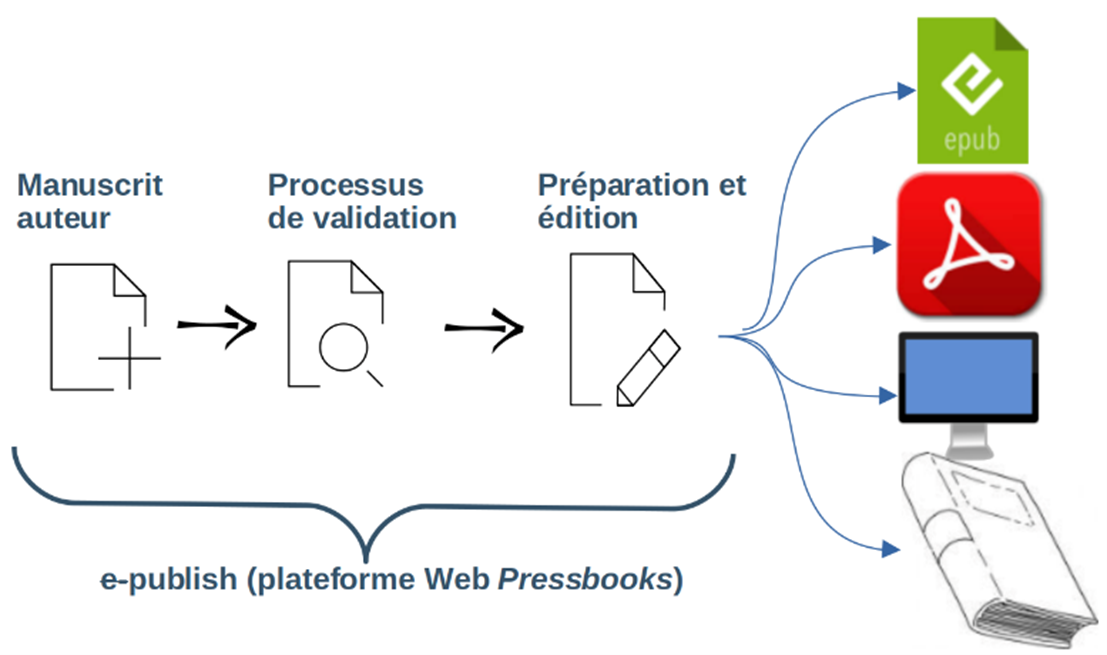
e-publish also enables authors to participate in and monitor the entire publishing process for their work, from drafting and proofreading through to layout, publication and distribution on digital platforms such as DOAB (Directory of Open Access Books), Google Books, etc.
e-publish also offers increased visibility. By using open licences (CC BY) and adhering to the latest standards for structured publishing, works published on e-publish are automatically made available as Open Access in various formats: HTML (for the web), ePub (for e-readers) and PDF (for on-screen reading and print-on-demand).
Les Presses universitaires de Liège has, in fact, adopted the principle of using e-publish for the editing and publication of Open Access works from 2020 onwards.
Are you an author affiliated with ULiège and do you have an e-book project you wish to publish, with or without a print edition? This project must be a manuscript to be submitted to Presses universitaires de Liège (co-publication) or a project that will be edited and published under the responsibility of ULiège Library.
The four books
Anatomie humaine – Bases pour une première approche
By Pierre Bonnet
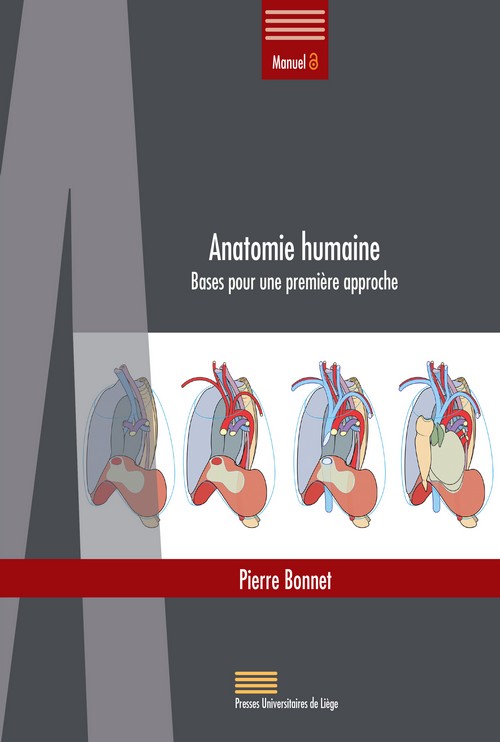
(In french) Ce livre, agrémenté de près de 700 illustrations sur 714 pages, constitue la référence anatomique pour les étudiant.e.s abordant la science anatomique en première année des études médicales telles qu’elles sont conçues à l’Université de Liège.
L’ouvrage donne une description schématisée des différents systèmes anatomiques tout en insistant sur leurs connections, l’approche est donc systémique avec une vision topographique. L’anatomie est progressivement construite en insistant sur l’observation et la description.
Dans une première partie, les notions d’intelligence spatiale sont expliquées et les codes de la description et du langage anatomique sont précisés. Un aperçu de la formation embryologique de l’être humain permet de construire un schéma simple de l’architecture du corps humain.
Dans la seconde partie, les différents systèmes anatomiques sont vus à partir de leur formation et en se basant sur une riche illustration originale, conçue en relation étroite avec le texte. Les liens sont évoqués avec l’anatomie microscopique, la physiologie voire la sémiologie.
La troisième partie, plus réduite, propose un aperçu de l’anatomie topographique de la tête, du tronc et des membres, permettant de mettre en relation les notions simplifiées vues dans la deuxième partie.
Par une approche didactique couvrant l’ensemble de l’anatomie, outre les étudiant.e.s en médecine, l’ouvrage intéressera l’ensemble des filières de la faculté de médecine (pharmacie, dentisterie, kinésithérapie, sciences de la motricité et sciences biomédicales) tout comme un public plus large.
Pierre Bonnet is a doctor (University of Liège, 1984), a specialist in urology (Sart Tilman University Hospital), holder of a PhD in experimental biomedical sciences and a postgraduate diploma in higher education pedagogy, taught anatomy at the University of Liège from 2001 to 2024. His interest in drawing led him to illustrate numerous articles on surgical techniques, anatomy and popular medical topics. The convergence of his passions for drawing, anatomy, medicine and teaching is the source of many of the diagrams that form the basis of this book.
Opening up our Heritage – Opportunities in Digitising and Promoting Cultural and Research Collections
By François Renaville, Renaud Adam and Cécile Oger (Eds.)
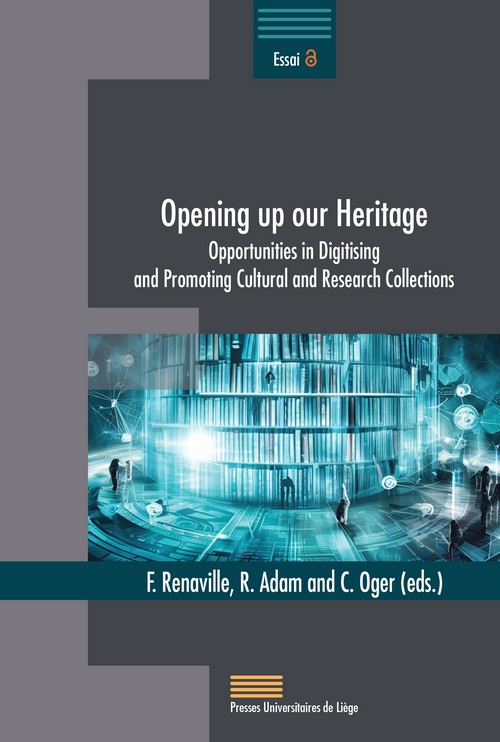
How can heritage institutions reconcile the duty to preserve fragile historical collections with the growing demand for open, digital access? This book explores that question through the lens of a European Erasmus Staff Training week, where librarians, curators, project managers, and researchers met to examine the challenges and opportunities of digitising and promoting cultural and research heritage. Opening Up Our Heritage offers a rich overview of current practices, institutional strategies, and collaborative projects that bring rare books, scientific instruments, photographs, and local archives into the digital age. With case studies drawn from across Europe, the Americas, and South Africa, the book highlights how technology can both safeguard and activate collections – ensuring their transmission to future generations while engaging new audiences today. Structured in four thematic parts – Preservation and Digitisation; Data Structuring and Connectivity; Promotion and Showcasing; and Community Engagement – it captures the diversity of approaches and shared ambitions in the cultural heritage sector. A timely and practical resource for professionals and academics alike, this volume sheds light on the dynamic intersection of heritage preservation, digital innovation, and public engagement.
François Renaville studied linguistics, literature and translation. He currently coordinates the Systems & Data unit at the University of Liège Library.
Renaud Adam (PhD, 2011) is a specialist in early modern book history and leads the digitisation unit at the University of Liège Library. He is also an associate member of the Gabriel Naudé Centre (Enssib, Lyon).
Cécile Oger (PhD, 2005) is an art historian specialising in the technological and archaeometric analysis of ancient paintings. She curates the manuscript, old and rare book collections at the University of Liège Library.
L’écriture académique au format texte avec Markdown et Pandoc
By Bernard Pochet
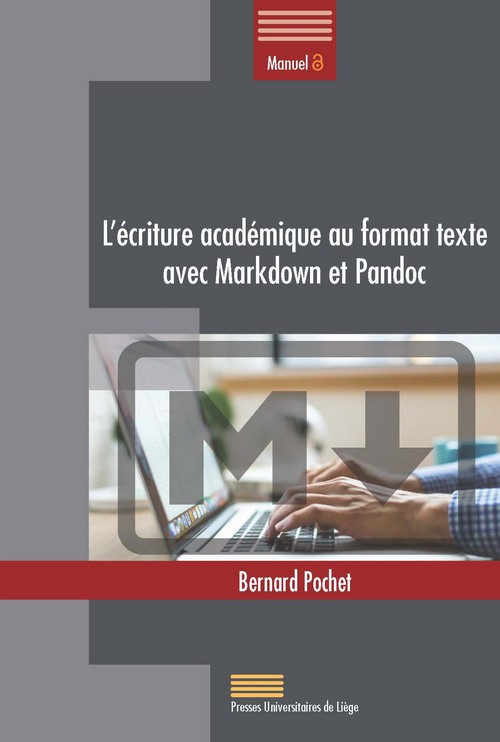
(In french) Cet ouvrage est une nouvelle édition, revue et largement augmentée, de « Markdown & vous », publié en 2023 sur la plateforme e-publish de l’Université de Liège.
L’écriture académique est au centre des activités des scientifiques. Que ce soit pour rédiger un article, un rapport, une présentation ou une participation à un ouvrage collectif, avec l’apparition de l’informatique, les méthodes, les outils et les formats ont beaucoup évolué ces trente dernières années. La machine à écrire est un vague souvenir et pourtant c’est maintenant le traitement de texte, dominé par Word, basé sur le même principe, qui est devenu l’outil principal. Les outils bureautiques proposent aux autrices et auteurs de régler pour eux les questions de format et de méthode avec des outils clé en main qui font progressivement perdre toute autonomie et maîtrise des processus techniques. Pour reprendre la main face à l’impératif fonctionnel et au capitalisme de surveillance de l’industrie informatique, il est indispensable de revoir nos méthodes, outils et formats. Cet ouvrage propose une réflexion sur une approche durable, ouverte et libre qui redonne la pleine maîtrise dans les activités de rédaction. Basé sur le format Markdown, un langage sémantique simple, lisible par les humains et pérenne grâce à sa simplicité syntaxique. Markdown permet de revenir à des méthodes qui vont à l’essentiel en faisant les choses dans l’ordre, écrire, illustrer, éditer puis publier, sans perte de temps et d’énergie inutiles. Le choix de Markdown supprime la dépendance à un logiciel spécifique, comme c’est le cas avec un traitement de texte.
Bernard Pochet, retraité depuis juin 2024, est titulaire d’un diplôme en sciences psycho-pédagogique (université de Mons), d’un diplôme en sciences de l’information (université libre de Bruxelles) et d’un doctorat (université de Liège). Il a été directeur de la bibliothèque des sciences agronomiques de l’Université de Liège de 1995 à 2020. Maître de conférence en littérature scientifique, il a également été directeur des presses universitaires de Gembloux pendant 25 ans et directeur de publication de plusieurs revues scientifiques. Il a terminé sa carrière comme responsable de la cellule d’édition numérique ouverte de la bibliothèque de l’Université de Liège et responsable de son pôle OpenScience. Il anime actuellement des ateliers de formations à Markdown pour les doctorants
The Taxonomy of the Legal Document : An Account of the Language and Terminology of Clauses in Greek Legal Documents from Ptolemaic, Roman and Byzantine Egypt
By Uri Yiftach
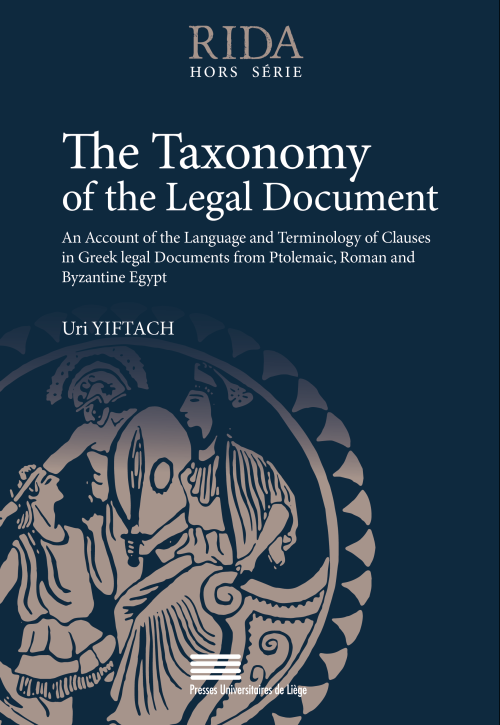
This book presents the results of a long-term investigation into the structure of Greek legal documents preserved on papyrus. It provides a clause-by-clause analysis of 281 formulations used in contracts, mostly from Egypt, spanning the early Hellenistic to the late Byzantine period. Designed as both a typology and a research tool, the study is based on the Synallagma database—a digital corpus first created with the support of the Israel Science Foundation and now hosted at the University of Münster. The approach is philological, quantitative, and comparative: each clause is examined for its syntactic form, legal function, and diachronic trajectory. The goal is to uncover the linguistic mechanisms by which scribes encoded rights, duties, and transfers of ownership. As a contribution to legal history and historical linguistics, the book offers an empirical foundation for the study of formulaic writing in antiquity—well beyond the specific body of sources it analyzes.
